Procurement as a Service for Q4: Is It Worth the Switch for Your 2027 Budget?
Procurement as a Service for Q4 is becoming a real question for many procurement teams right now. Over the next few weeks, purchasing departments will decide what 2027 looks like — budget, suppliers, processes. One question keeps coming up more often: does it make sense to hand off operational procurement tasks to an external provider before the new year starts?
What Is Procurement as a Service, Exactly?
Procurement as a Service means an external full-service procurement provider takes over the non-value-adding tasks in purchasing — supplier sourcing, one-time orders, rogue spend control, day-to-day procurement — while the internal team focuses on strategic decisions. It is not a software product or a platform. It is a service model: a team takes on tasks that would otherwise tie up internal capacity.
Why Q4 Is the Right Moment to Check
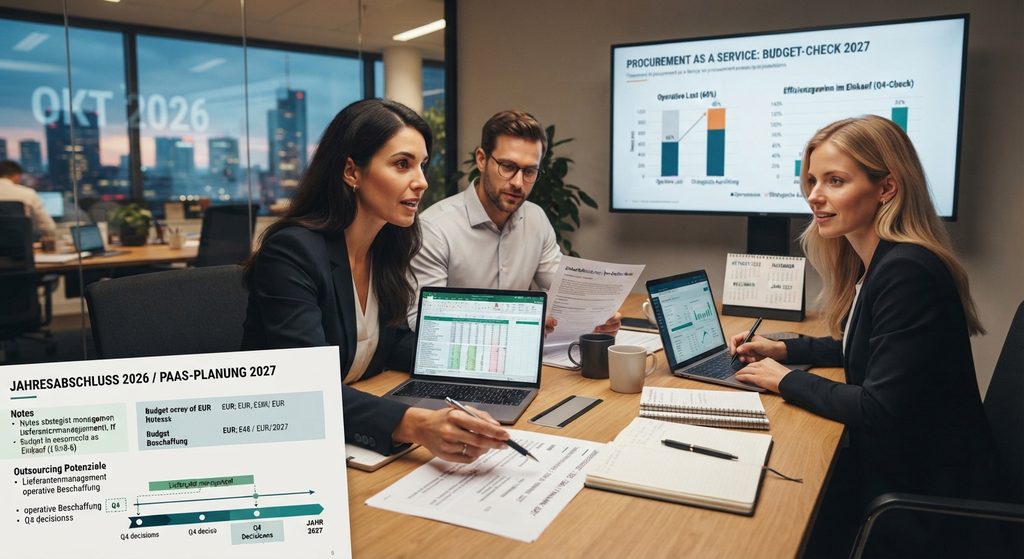
Contracts that renew automatically. A budget that needs to be justified internally. Suppliers the team might not choose again if deciding today. All of that comes together in Q4 — and the decisions made now shape the entire following year.
That is exactly why Procurement as a Service for Q4 is worth evaluating now: teams that check this in October start the new year with a clearer starting point, instead of asking the same question under time pressure in March 2027.
What does Procurement as a Service cost?
Costs depend on scope, but there are useful benchmarks:
Managing a single supplier typically costs companies between 500 and 1,500 euros per year, regardless of order value. Across many small and mid-sized suppliers, that adds up to an amount that rarely shows up as its own line item.
Strategic procurement teams often spend up to 60 percent of their time on operational tasks instead of negotiation, risk management, or supplier development. Procurement as a Service shifts exactly that share of the workload.
For unmanaged material categories, the first competitive RFQ typically delivers savings of 15 to 30 percent — potential that usually stays invisible without a structured process.
How Does the Switch Work?
A central piece of the model is the single-creditor approach: instead of managing 500 suppliers with 500 different payment terms, there is one point of contact and one consolidated invoice. That cuts process costs by roughly 40 percent and gives full spend visibility from day one.
The provider handles the full operational flow — from supplier sourcing and qualification through order processing to complaint handling. The internal team stays responsible for strategic A-items and overall procurement strategy; Procurement as a Service doesn’t replace the team, it extends its operational capacity.
Who Should Consider It?
The model is particularly relevant for:
Mid-market companies with 50 to 500 employees and indirect spend above 500,000 euros per year that don’t have a dedicated procurement team, or whose team is overloaded with operational work.
Companies going through transformation — M&A, carve-outs, restructuring — that need new procurement processes quickly.
Teams actively driving EBITDA improvement and process digitalization that need measurable results in the short term.
Checklist: 4 Decisions Before Year-End
- Which supplier contracts renew automatically — and should they?
- Is the 2027 budget backed by real numbers, not just estimates?
- Which suppliers would the team not choose again today?
- Are KPIs for cost, risk, and supplier performance defined for the year ahead?
Teams that answer these four questions in October start the new year noticeably calmer than teams that wait until December.
What exactly is Procurement as a Service?
An external full-service procurement provider takes over the operational, non-value-adding tasks in purchasing — from supplier sourcing to complaint handling. It’s a service model, not software or a platform.
What does Procurement as a Service cost?
Costs depend on scope. As a benchmark: managing a single supplier typically costs companies between 500 and 1,500 euros per year — an amount that adds up quickly once you count every supplier.
How is Procurement as a Service different from a procurement platform or software?
A platform provides technology that the internal team operates itself. Procurement as a Service is a service model: an external team carries out the tasks directly, not just the tool for doing them.
Which companies benefit most from Procurement as a Service?
Mainly mid-market companies with 50 to 500 employees and indirect spend above 500,000 euros per year that lack a dedicated procurement team or whose team is operationally overloaded.
Does Procurement as a Service replace the internal procurement team?
No. The internal team stays responsible for strategic decisions and A-items — Procurement as a Service extends operational capacity, it doesn’t replace the team.
If you’d like to see what Procurement as a Service could look like for your purchasing volume, we’re happy to talk it through, no strings attached.
Follow Provendor on LinkedIn to learn more about our company, our services, and exclusive insights into our processes.